
deep-story-novels-for readers
Deep Story Novels for Readers Who Want More Than a Plot
Some books move fast. Things happen, chapters turn, the ending arrives and two weeks later you cannot remember the names of the people in it.
Then there are the books that go down rather than forward. The ones that put you inside a life so completely that by the time you surface, something has shifted in the way you think about people and where they come from and what it costs to get from one place to another.
Another Feg is the second kind of book.
Jim Green does not rush his material. He started writing in 2004 and took twenty years to finish because the life kept going and the book kept needing to account for it. What that produces is a memoir with genuine depth, not the kind that comes from literary technique, but the kind that comes from a writer who understood that the details other people skip are the ones that actually explain things.
Why his mother’s good coat went in and out of the pawn shop on New Sneddon Street. Why his father took a debt collecting job for an illegal bookies on top of a sixty-hour week on a building site. Why Grannie Isa, who had already lost two sons, stitched her grandson into a pigskin vest with butcher’s twine rather than risk losing another one to a chest infection.
Those details are not colour. They are the story. Jim Green knows the difference, and he never lets the reader forget it.

The Depth Underneath the Surface of Another Feg
On the surface, Another Feg is a memoir about growing up poor in Paisley in the 1950s and 60s and making something of yourself despite it. That reading is not wrong. It is just not the whole picture.
Underneath it is a book about inheritance, what gets passed down through families who have nothing to pass down except character. Jim’s grandfather Punty, who sat reading the evening papers with half a lung, the other half taken by mustard gas on the Western Front in the First World War. His father Jimmy, ex-Argyll and Sutherland Highlanders, army boxing champion, who solved problems with his fists because that was the tool he had been given and it had served him well enough in the army. Uncle Sammy, who taught two boys the capitals of the world from tea cards and was simultaneously one of the most feared men in Paisley.
These men did not sit Jim down and explain life to him. They demonstrated it, chapter by chapter, year by year, in the way they handled money and neighbours and danger and each other. Jim watched and absorbed and carried it forward, into university, into business, into politics, into the offshore platforms in the North Sea where his decisions affected other people’s survival.
The distance between Punty reading the Evening Times in a new tenement flat and Jim Green attending the Queen’s Garden Parties is two generations. Another Feg is the account of how that distance was covered, and by whom, and what it actually took.

Meaningful Fiction Books for Readers: What Another Feg Is Really About
Meaning in a book does not come from the subject matter. It comes from the writer’s honesty about it.
Jim Green is honest about his life in a way that is genuinely uncommon in memoir. He does not arrange his failures to make them look like stepping stones. The bankruptcy is not presented as the necessary precondition for the comeback. It is presented as a bankruptcy, something that cost him his business, his standing and eventually his country, when he had to leave Scotland and move to a farm in Denmark to try and rebuild.
He is honest about his father in the same way. Jimmy Green was a man of considerable gifts, physically powerful, charismatic, loyal to his family beyond question, who also solved disputes with violence and supplemented his income collecting debts for people who operated outside the law. Jim does not explain this away. He records it as a fact of the life, which is what it was.
He is honest about his own near-death experiences without turning them into drama. The two gang attacks and the two occasions he was shot at are mentioned in the introduction in a single sentence, alongside Westminster and the Queen’s Garden Parties, as if they are simply part of the same inventory of a life, which, in Jim’s case, they are.
That refusal to manage the material, to curate a version of himself that is easier to admire, is what gives Another Feg its meaning. It is a book about a real person who did not always get it right and never pretended otherwise

The Meaning of Coming Back to Feegie
Jim Green lives six miles from Ferguslie Park. He has lived in Denmark, in the Lake District, in London, in Aberdeen. He has worked across the North and Irish Seas. He has stood in Downing Street and sat in the Queen’s garden.
He came back six miles from Feegie.
That is not incidental. In Another Feg the proximity to Ferguslie Park is the book’s quiet insistence that where you come from does not stop being where you come from just because you have been elsewhere. Jim never positioned his Feegie background as something to overcome. He carried it as an identity, one that the social stigma he mentions in the introduction tried to make a liability and that he consistently refused to treat as one.
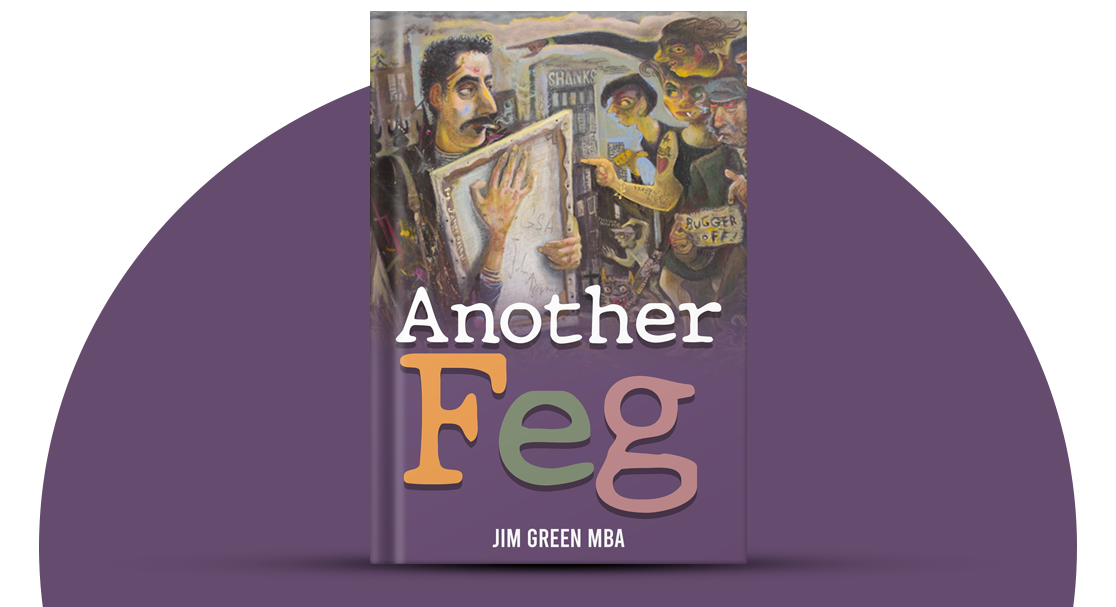
The cover artwork makes the same point. John Byrne, one of Scotland’s most celebrated artists and playwrights, was commissioned to produce the front cover image after his own connection to Feegie. He is also a Feg. The book’s cover is therefore the work of two men from Ferguslie Park, one who wrote the life down and one who drew it, both of whom went a very long way from the scheme and both of whom remained, in the only sense that matters, exactly where they started
That is the most meaningful thing Another Feg says, and it says it without ever needing to spell it out.

The Chapters That Carry the Most Weight
Not every chapter in Another Feg carries equal weight. Some are inventory, the months and years ticked through in the diary format Jim uses across the early sections. But certain chapters sit differently once you have read them.
The chapter where Charlie, Jim’s brother, wins the school Dux prize in his final year, first place across the whole school, while Jim picks up third prize and a French dictionary. Sammy’s tea card education worked on both of them. It worked differently. Jim records this without self-pity and without false modesty. Charlie won. Jim got the French dictionary. Both of them got further than Feegie expected
The chapter where Jim’s sister Ellen Rosina is born at home with the cord around her neck three times, born blue, taken by ambulance to Killearn sick children’s hospital near Loch Lomond. His father telephoning every day because visiting was out of the question. His mother frantic. And then the pink bundle coming home, and Jim and Charlie getting to help with the bathing and the changing, and Jim noticing, with the candid logic of a four-year-old, that this baby had no willie.
The final pages, where Jim describes finishing the manuscript in the shadow of a near-fatal heart attack, submitting it to Amazon and giving copies to friends as Christmas stocking fillers. The matter-of-factness of that ending, after everything the book contains, is the most affecting thing in it.
Buy Now on Amazon
A Life With Actual Depth. Every Word of It True.
Another Feg is not a book that tells you what to take from it. It puts a life in front of you, all of it, the difficult parts alongside the extraordinary ones, and trusts you to find what matters
Jim Green started writing it at fifty. He finished it at seventy-four, in the knowledge that he was running out of time to do so. What he produced is a memoir that goes deeper than most fiction tries to, because the life it records actually did.
FAQS
What are deep story novels for readers?
Deep story novels are books with layered narratives, complex characters, and themes that provoke thought, reflection, and emotional engagement. They often explore human nature, society, and personal growth.
What qualifies as meaningful fiction books for readers?
Meaningful fiction books are stories that carry a significant message or life lesson, inspiring readers while entertaining them. They often address universal experiences such as love, loss, resilience, or morality.
Why should readers choose deep and meaningful fiction?
Such books provide more than just entertainment; they encourage empathy, critical thinking, and self-reflection. They can leave a lasting impact on a reader’s perspective and personal growth.
Can memoirs be considered deep story novels or meaningful fiction?
Yes, memoirs like Another Feg by Jim Green blend real-life experiences with storytelling elements, offering profound insights and meaningful reflections that resonate like fiction.
Which genres often include deep story novels and meaningful fiction?
Literary fiction, contemporary fiction, historical fiction, and philosophical novels frequently provide deep and meaningful narratives for readers seeking thoughtful and engaging stories.
“My life has been eventful, challenging, frightening, sad, happy, adventurous and wonderful. I remain without fear and unvanquished.”

— Jim Green, January 2025